
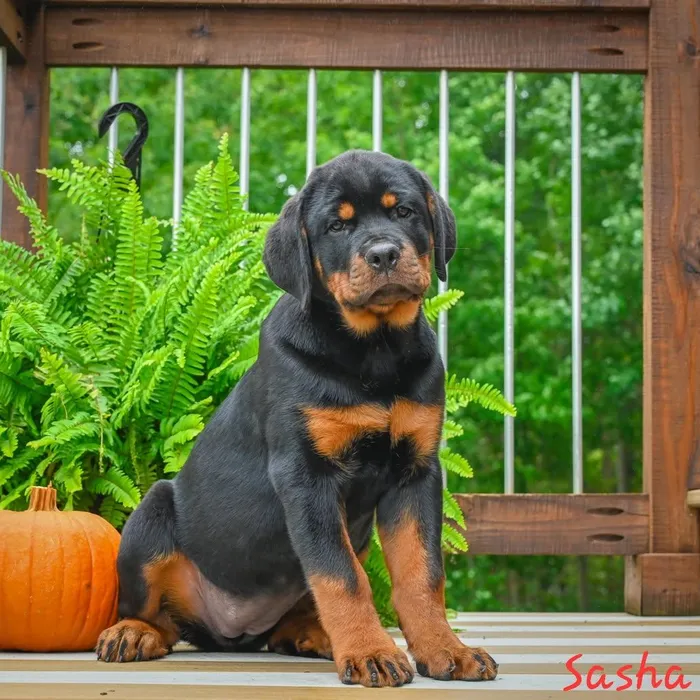
For you, pickup day is the happy ending to weeks of waiting. For your puppy, it is the day everything changes at once. Understanding what those first days and nights feel like from your puppy’s side is the best thing you can do to help your new Rottweiler settle in.
We have sent a lot of puppies home from our farm in Charm, Ohio. Here is what we have learned about making that first week as calm and happy as possible for everyone, especially the puppy.
Your puppy’s world, the day before you arrive
Picture your puppy’s life the night before you come. It has spent every one of its roughly eight weeks in the same place. It sleeps in a warm pile of brothers and sisters, with its mother close by. It knows the smells of our farm, the sound of our voices and the rhythm of the day. When it wakes up in the night, a littermate is right there, breathing and warm.
Your puppy has never been alone. Not once.
Moving day, from your puppy’s side
Then one morning, new hands pick it up. It rides in a car for the first time, feeling the motion and the engine and the strange smells. It arrives at a house where nothing smells familiar, the floors feel different and the voices are new. Its mother is gone. Its littermates are gone. Even the people it knows are gone.
To make it harder, most puppies go through their first fear period somewhere between eight and eleven weeks of age, right around the time they go home. During those weeks, puppies startle more easily and new things can feel bigger and scarier than they really are.
Your puppy is not being difficult. Its whole world has just turned upside down, and it is looking to you to make it right again.
So be patient, keep things quiet and give your puppy time. Most puppies start to relax within a few days, and by the end of the first week many act like they have lived with you forever.
What we send home with your puppy
Every puppy leaves our farm microchipped, with a bag of the food it has been eating, a leash and collar, a puppy guide, its shot and deworming records and the application to register your puppy with the AKC. Keep those records handy for your first vet visit. You can see the full list on our adoption package page.
Before pickup: get your home ready
Have everything in place before your puppy arrives, so the first day can be about the puppy and not a trip to the store.
- A crate sized for an adult Rottweiler, with a divider panel. Set the divider so your puppy has just enough room to stand, turn around and lie down. You will move it back as your puppy grows.
- A spot for the crate in your bedroom for the first weeks. More on why below.
- A small puppy-safe area, like a playpen or a gated kitchen, for awake time when you can’t watch every second.
- Food and water bowls, plus the food we send home.
- Safe chew toys sized for a strong puppy with a powerful bite.
- An enzyme cleaner for accidents. It removes the scent so your puppy is less likely to go in the same spot again.
- A vet appointment already booked for the first week.
Then get down on the floor and look around at puppy height. Pick up shoes, socks, cords, kids’ toys, houseplants and anything small enough to swallow. A Rottweiler puppy explores with its mouth.
The ride home
We love meeting families at the farm, and picking up your puppy in person is the best way to start. If the trip is not possible, see our pickup and delivery options.
If you can, bring a second person so one of you can drive while the other sits with the puppy. Bring old towels and a roll of paper towels. Many puppies ride quietly and fall asleep. Some drool or get a little carsick on their first car trip. That is normal and usually passes as they get used to riding.
On a long drive, stop every couple of hours for a short potty break on a leash. Choose a quiet patch of grass away from the main pet area at rest stops. Your puppy has not finished its vaccinations, and those busy spots are where other dogs have been.
The first hour at home
Carry your puppy straight to the spot in your yard where you want it to go potty. Wait quietly, and when it goes, praise it calmly. Then bring it inside to its small area and let it sniff and explore at its own pace.
Keep the welcome low-key. Ask children to sit on the floor and let the puppy come to them instead of picking it up or crowding around. Save the visits from friends and family for later. Right now your puppy needs a quiet place to figure out that it is safe.
The first night, through your puppy’s eyes
Night is the hardest part. The house goes dark and quiet. For the first time in its life, there is no warm body beside your puppy, no heartbeat, no littermate to snuggle against. It is perfectly natural for a puppy in that situation to cry. It is not trying to manipulate you, and it does not mean you are doing anything wrong. It is calling for its family.
Here is how to help:
- Put the crate right beside your bed. Your puppy can hear you breathing and smell you nearby, which is the next best thing to a littermate. You can also rest your fingers against the crate door to let your puppy know you are there.
- Give a soft blanket or towel in the crate for comfort. Watch that your puppy does not chew it up.
- Take your puppy out for one last potty break right before bed.
- Plan to get up in the night. Many eight-week-old puppies cannot hold it all night yet. If your puppy wakes and cries, carry it outside, let it go, praise it, and bring it right back to the crate. Keep the lights low and skip the play, so your puppy learns that night is for sleeping.
- Stay calm and consistent. A quiet word is fine. Taking the puppy into your bed or making a big fuss can teach it that crying gets a party.
The first night is often the loudest. Most puppies cry less on the second night and less again on the third. Before long, your puppy will walk into its crate on its own to sleep.
The first few days
Let your puppy sleep. A young puppy sleeps somewhere around eighteen to twenty hours a day. That is not laziness. It is how a growing body and brain recover. Do not wake a sleeping puppy to play, and make sure children understand that a napping puppy is off limits.
Keep a potty schedule. Take your puppy out when it wakes up, after it eats, after it plays and every hour or two in between while it is awake. Go to the same spot each time and praise it when it goes. Accidents will happen. Clean them up with enzyme cleaner and never scold, which only teaches a puppy to hide from you when it needs to go.
Watch the tummy. The stress of moving, plus new water, can upset a puppy’s stomach for a day or two. If your puppy has diarrhea for more than a day, vomits, stops eating or seems unusually tired, call your veterinarian right away.
Feeding your growing Rottweiler
Keep feeding the food we send home, at the same times each day. If you decide to switch foods later, mix the new food in gradually over about a week to avoid an upset stomach.
Large breeds like the Rottweiler do best on a food made for large-breed puppies. These foods are balanced to support slow, steady bone growth. Large-breed puppies are sensitive to too much or too little calcium while their bones are developing, so do not add calcium or other supplements unless your veterinarian tells you to. Keep your puppy lean. Extra weight puts extra strain on growing joints.
Growing joints: what every Rottweiler owner should know
A Rottweiler puppy grows remarkably fast, and its bones are still soft and developing. The growth plates in large breeds do not close until about sixteen to eighteen months of age. Until then, protect those joints:
- Let your puppy set its own pace in play, on grass or other soft surfaces.
- Skip jogging, long hikes and repetitive running on pavement until your veterinarian says your dog is ready.
- Carry your puppy up and down stairs while it is young, and keep stair use to a minimum as it grows.
- Do not let your puppy jump off furniture or out of the car. Lift it instead.
Start good habits now
Here is the most important thing to remember about raising a Rottweiler: whatever is cute at fifteen pounds will not be cute at one hundred and fifteen. Start the habits you want from the very first day.
- No jumping up. Greet your puppy when all four paws are on the floor.
- Gentle mouths. Puppies explore with their teeth. When yours mouths your hands, calmly offer a chew toy instead.
- Handling every day. Gently touch your puppy’s paws, ears and mouth so nail trims and vet visits stay easy for life.
- First lessons. Your puppy’s name, sit and coming when called can all begin this week, in short, happy sessions of a few minutes.
- A happy crate. Feed meals in the crate and offer a treat when your puppy goes in, so the crate becomes a favorite place.
Children and a new puppy
Rottweilers and children can share a wonderful bond. Help it start right. Have children sit on the floor to hold and pet the puppy, since a wiggly puppy can easily be dropped. Teach them to be gentle, to let the puppy sleep and eat in peace, and never to chase it. Always have an adult supervise, and let the adults handle training and walks.
Keep your puppy safe until its vaccinations are finished
Your puppy needs its full series of vaccinations before it is protected from serious diseases like parvovirus. Until your veterinarian says your puppy is ready, avoid dog parks, pet store floors, busy rest areas and anywhere unknown dogs spend time.
That does not mean keeping your puppy home alone. This is still a key time for socialization. Carry your puppy to new places, let it watch the world from your arms or the car, and invite calm, healthy, vaccinated dogs and gentle people over to meet it. Ask your veterinarian about puppy classes that require vaccination records.
The first vet visit
Take your puppy to your veterinarian during the first week. Bring the health records we sent home so your vet can see which vaccinations and dewormings have already been given and plan the rest. It is also a good chance to ask about food, parasite prevention and when to start puppy classes. You can read the details of our coverage on our health guarantee page.
A simple day for an eight-week-old puppy
- Wake up: straight outside to potty, then breakfast and another potty trip.
- Morning: a short play and training session, then a nap in the crate or pen.
- Midday: potty, lunch, potty, a little quiet exploring, another nap.
- Afternoon: potty, gentle play, handling practice, nap.
- Evening: potty, dinner, potty, calm time with the family.
- Bedtime: one last potty trip, then the crate beside your bed.
- Overnight: a quiet, boring potty break or two if your puppy wakes and cries.
Every puppy is different, so use this as a starting point and adjust to your puppy.
It gets easier, and we are always here
The first week can feel like a lot. The short nights, the potty trips and the learning are all part of it, and it passes quickly. Before you know it, your puppy will know its name, sleep through the night and follow you from room to room like it has always been part of your family.
You are never on your own with one of our puppies. If you have questions, big or small, call or text Mary at 330-521-0810 or Jonas at 330-893-0716. We love hearing how our puppies are settling in, and we are always happy to see a photo.